Change annotation visibility, Video Preview, the automatic page-turn control strip, display pattern, scroll direction, and auto-follow without leaving the score.
Score Viewer Display Menu
Score Viewer Display Menu
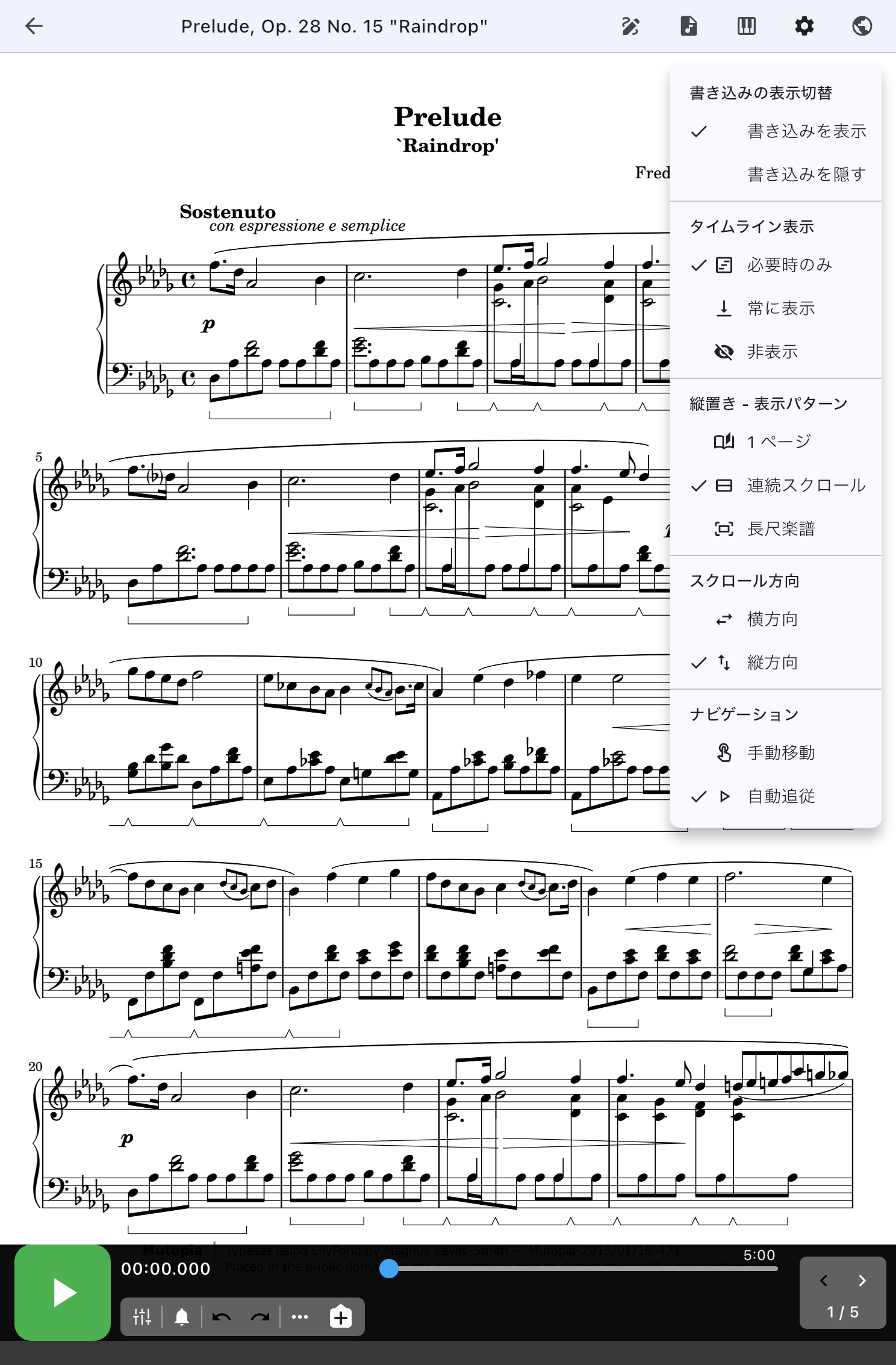
Display in the Score Viewer's top bar opens a menu for changing how the score looks without closing the performance screen. Use it for "hide the markings on just this song", "make it 2 in 1 in landscape", or "try auto-follow in continuous scroll".
Where Changes Are Saved
When the song came from a setlist, what you change here is saved as that one song's own display setting. That makes the menu right for "this song should look different".
When you opened the score directly from the library, display pattern and timeline display are saved to Global Settings. Annotation visibility is easiest to think of as a toggle that applies while you are looking at that score.
Showing and Hiding Annotations
On PDF and image scores, use the Toggle annotations check mark to control whether markings are visible. Checked shows the markings; unchecked hides them. This does not erase anything; it only changes what you see for now.
Clear the check mark when there are too many markings to read on stage. Check it when you want to review your markings at rehearsal, or when you move to a neighboring song and want to see them.
If annotations are hidden and you start annotating, the app shows them again so you are not writing into an invisible layer.
If Annotation Visibility Reverts
If the setting has gone back when you reopen the score, check it again. If it keeps reverting, that may be a bug — tell us what you did when it happened. Hiding annotations never deletes them.
Timeline Display
The app calls the bottom control strip — the one showing audio or timer position, cues, and the playhead — the "timeline". On songs with automatic page turns, you can show it When Needed, Always, or Hidden.
- When Needed: Pick this if you are unsure. It appears on songs that use audio or automatic page turns and stays out of the way otherwise.
- Always: For playing while watching cues and playback position, or checking page-turn points at rehearsal.
- Hidden: For songs that have a timeline but where you only want the score during the performance.
For more on the thinking behind it, see Timeline Settings.
Video Preview
For a song whose sound source is a video, turn Video Preview on to monitor the current picture over the score. It is intended for performances where the audience screen is behind the performer, and for rehearsals without an external screen.
When video is also being sent to an external display, the preview continues to show the same video and playback position. Turning the preview off does not stop external video or audio. If you collapse it, use the video icon on the score to reopen it. Its own menu and drag gesture change its size and position.
For moving, sizing, folding, and troubleshooting the window, see Video Preview. For the audience display and connection paths, see Video on an External Display.
Display Pattern
Which options are listed depends on how the device is held. The display pattern is saved for the current orientation, so you can use 1 Page in portrait and 2 in 1 in landscape.
- 1 Page: Read one page as large as possible.
- 2 in 1: See the flow across a spread in landscape.
- 2 in 1 Half: Keep the feel of a spread while advancing half a page at a time.
- Continuous Scroll: Read long scores or text-like pages as one flow.
- Wide: Listed in landscape. Reads a tall score width-first.
- Long Score: Listed in portrait. Reads a tall score width-first.
The extra options below depend on which pattern you choose.
Scroll Direction
Patterns that support it let you choose Horizontal or Vertical. Horizontal feels closer to turning pages; vertical suits reading the score from top to bottom.
Navigation
Continuous scrolling patterns let you choose between Manual Navigation and Auto Follow.
- Manual Navigation: You scroll and move pages yourself.
- Auto Follow: The screen advances with the audio or timer position.
Auto Follow needs audio and automatic page turns set up in advance. If it does not behave as expected, check in Item Settings that audio and automatic page turns are chosen for this song.
Global Settings vs. One Song
Use Global Settings when every song should look the same. Use this menu or the display settings in Item Settings when only one song should change.
Related Screens
- For the performance screen as a whole, see Score Viewer.
- To write the markings themselves, see Annotation Palette.
- For the finer timeline settings, see Timeline Settings.
- To use the floating video window, see Video Preview.
- To send video to the audience screen, see Video on an External Display.