The palette for the pen, highlighter, stamps, text labels, and eraser you use on a score.
Annotation Palette
Annotation Palette
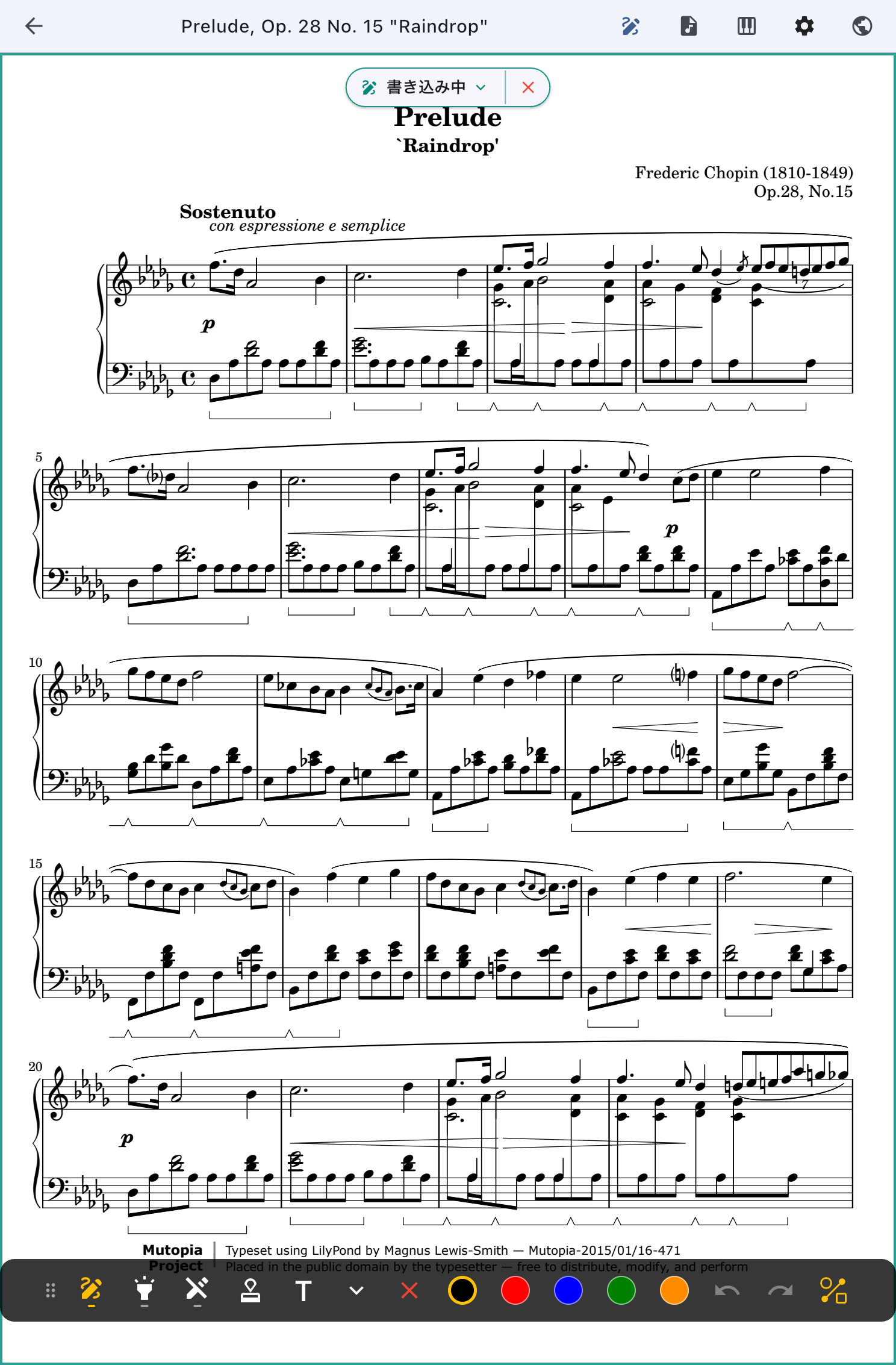
The annotation palette is the toolbox for writing directly on PDF and image scores. Use it for rehearsal notes, fingering, dynamics, cuts, page-turn marks — anything you want to see again while performing. A quick way to remember it: a line is the pen, emphasis is the highlighter, a symbol is a stamp, words are a text label, and removing is the eraser.
If you need to change the actual text of a text page or ChordPro chart, use Text Page Editor instead of annotations.
Opening and Closing
Annotate in the Score Viewer's top bar puts you in annotation mode. The green check button at the top of the screen, Finish Annotating, takes you back out. You can drag the palette to a spot where it covers less of the score.
While you are annotating, strokes, stamps, and text labels are saved to the page you drew them on. In 2-in-1 view, a stroke that begins on the left page belongs to the left page. To annotate the adjacent page, lift the pen and start again on that page.
Pen and Highlighter
Use the pen when you want a clear line. Use the highlighter when you want to draw attention to notes or lyrics while keeping them readable.
The colors are black, red, blue, green, and orange. Long-press the pen or highlighter icon to choose the line width.
Stamps
Stamps are for quickly placing the symbols you often add to a score: fingering, pedal marks, accidentals, dynamics, bowing, ornaments, and navigation signs. Tap Stamp and Text Labels on the palette, choose Stamp, then pick a category along the top. Stamps you have used show up under Recent the next time.
- Once you choose a stamp, the palette switches to Tap the score to place and waits. The red X cancels.
- Tap the score once where you want it. The current color and the last size you used are applied automatically.
- The stamp stays selected, so adjust its position, color, size, or symbol, then confirm with the green check button.
For the next stamp, go back to the object menu and choose again.
Text Labels
Text labels are for free-form reminders, lyrics, chords, and performance notes. They can hold several lines, and the whole label can be aligned left, center, or right and set to Bold, Italic (Latin, Greek, Cyrillic), or Underline.
Open Stamp and Text Labels, choose Text Label, enter the text and formatting, then choose Place. The label appears at the center of the score you can currently see and stays selected. Use the edit icon to change the text, adjust its position, color, size, alignment, and formatting, then confirm with the green check button.
Japanese glyphs are never slanted, so they keep their intended shape. Italic (Latin, Greek, Cyrillic) can only be chosen for labels that contain those scripts.
Selecting, Moving, and Editing Annotations
Select, Move, and Edit is its own button on the regular palette, and it picks up pen strokes, highlighter strokes, stamps, and text labels the same way. Where annotations overlap, the frontmost one is selected regardless of type. The selection gets an animated dashed frame, and the regular tools are replaced by the editing palette for that kind of annotation.
- Drag inside the frame to move it.
- Pen and highlighter strokes can be reset to any of the same five widths used when drawing.
- Stamps and text labels have a size slider that scales them without moving their center. You can also tap the point value and type a size.
- A stamp's symbol can be changed; a text label's text, alignment, Bold, Italic (Latin, Greek, Cyrillic), and Underline can be changed.
- Choosing a color recolors only the selected annotation.
- The trash button deletes the selection.
- Tap blank space or press the green check button to confirm.
While something is selected, selecting and moving annotations takes priority over the page-turn tap zones. That way you can adjust an annotation near the edge without the page moving under you.
Eraser
The eraser removes one whole annotation at a time: an entire pen or highlighter stroke, or the whole stamp or text label you touch. There is no partial erasing and no eraser width.
Drag to keep deleting whatever you touch. Where a stamp or text label overlaps a stroke, the whole object goes first; where two of the same kind overlap, the frontmost one goes. If you delete something by mistake, Undo brings it straight back.
Undo and Redo
Undo / Redo reverses your last mark or deletion. For a stroke that shape recognition cleaned up, the first Undo returns the rough hand-drawn stroke; a second Undo removes it entirely.
Shape Recognition
Draw a rough circle, oval, straight line, rectangle, or triangle with the pen or highlighter, then pause briefly without lifting. It turns into a clean shape. Handy when you have scribbled a circle around a tricky bar and want it readable. Shape recognition is always on, but it only fires when you hold still right after drawing. Lift normally and the stroke is saved exactly as you drew it.
Stylus Only
When you use an active stylus, hiding the palette can switch the score into Stylus Only. In that state the stylus writes and your fingers are free to move and operate the score.
It helps when you want to avoid stray marks from a palm or finger during a performance. To draw with your finger again, turn off the Stylus Only indicator on the palette.
Hiding Annotations
To put markings out of sight without erasing them, clear the Toggle annotations check mark in the Score Viewer Display Menu. That lets you hide them for the show and show them at rehearsal.
When Saving or Loading Fails
- "Could not save annotations. Try again." appears — Press Try Again on screen while you are still on the page where the error appeared. If the error is about the storage limit, clear out annotations you no longer need first. If you have moved to another page since, an old Try Again is not guaranteed to target the page that failed. If Try Again does nothing or the failures continue, do not assume the markings were saved — tell us the score and page, the message you saw, and what you did.
- "Failed to load annotations." appears — First check that Toggle annotations is checked in the Display Menu. If it really was a load failure, move to another page and back to load them again. If it fails again, do not conclude the annotations were deleted — tell us the score, the page, and the message you saw.
Related Screens
- For the performance screen as a whole, see Score Viewer.
- To change only what is visible, see Score Viewer Display Menu.
- If markings make the score hard to read, consider hiding them rather than deleting them.