Choose which songs to include in a setlist share, decide whether to include annotations and tags, and send via QR code or archive file.
Send a Setlist
Send a Setlist
Use this screen when you need to distribute a setlist to band members or duplicate it to another device. You can pick which songs to include and choose whether to send annotations and per-song display settings along with them. Sending a setlist can also carry the selected songs' page ranges, audio, timelines, tempo settings, and setlist memos.
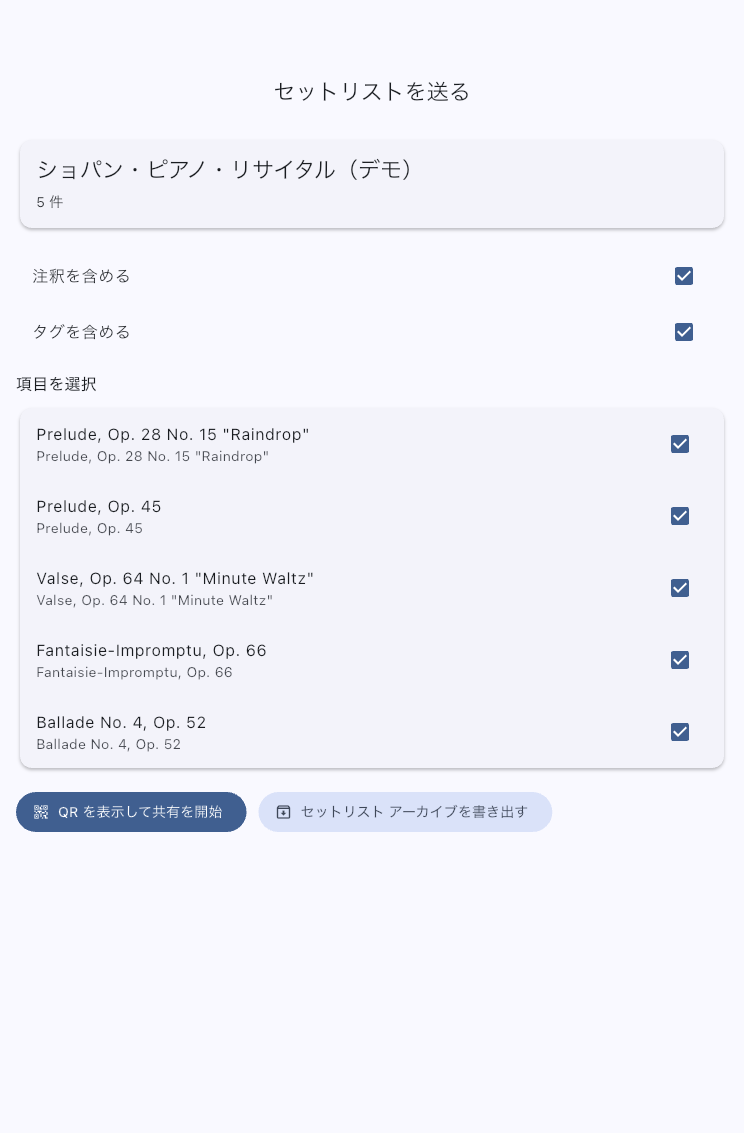
What to Decide on This Screen
- Whether to include annotations
- Whether to include tags
- Whether to include per-song display settings
- Which songs in the setlist to share
On the sender side, audio and timelines linked to the selected songs are placed in the archive with the setlist. The receiver can still remove audio or timeline per song in the import preview.
Why Send a Setlist
Setlist sharing is not just a way to send several scores at once. It sends the running order and the selected settings for each song: page ranges, audio and timelines, tempo, display settings, and setlist memos.
Use it when:
- Every band member should receive the same song order.
- MC notes, breaks, instrument changes, or other setlist memos should travel with the list.
- You want to send the rehearsal running order and display settings to another device.
- The recipient should receive the flow of the show, not isolated score files.
Sending Selected Songs
You do not have to send the entire setlist as-is. You can choose to send only the songs you will use in the show, or just the songs you want someone to update. When you send only some songs, memos are kept only if they sit immediately before or after one of the selected songs. Memos that only made sense around unselected songs are not sent.
Annotations, Tags, and Display Settings
Include annotations when the recipient should get your markings on the score. Leave them out when each musician will mark up their own copy.
Include tags when the recipient should inherit your organization across the setlist, songs, scores, audio, and timelines. Leave tags out when they are only useful in your own library.
Include per-song display settings when you want song-specific exceptions to be recreated, such as a different landscape display pattern or larger text-page layout for one song. Leave them out when the recipient should use their own global display settings.
Current setlist sharing (
.ppva) does not transfer Voice Count settings, even when timelines or display settings are included. Voice Count is off for the recipient; A/B/C bar selections are blank and the voice type is reset to its default. Configure these settings again after import if needed.
Send via QR Code
QR is the quickest way to hand off to another device on the spot. Once the recipient scans the code, the transfer starts immediately. Use it when both devices are on the same Wi-Fi network and the recipient is nearby.
Send via Archive
If you want to keep a file copy, use "Export Setlist Archive" to create a file.
Handy when you plan to deliver it later through another channel.
Setlist archives use the .ppva extension.
They are shared-data files, not full app backups (.ppbk).
If You Get Stuck
- If the recipient cannot connect, check that both devices are on the same Wi-Fi network and that the app has been granted Local Network access.
- If a Wi-Fi transfer on the spot is not practical, use "Export Setlist Archive" to create a file and send it via AirDrop or cloud storage. The recipient can import it using "Receive as a file" in Receive Shared Data.
- If you do not want the recipient to import audio or timelines, ask them to remove those items in the receive preview. For sender-side per-song control, use Send a Song.
- If fewer memos arrive than expected, check whether those memos were adjacent to the songs selected for sharing.
- If Voice Count disappeared after sharing, this is expected for current
.ppvashares. Turn Voice Count on again and reconfigure its A/B/C bar selections and voice type on the receiving device.
Related Screens
- To send just one song, use Send a Song.
- For instructions on the recipient's side, see Receive Shared Data.